
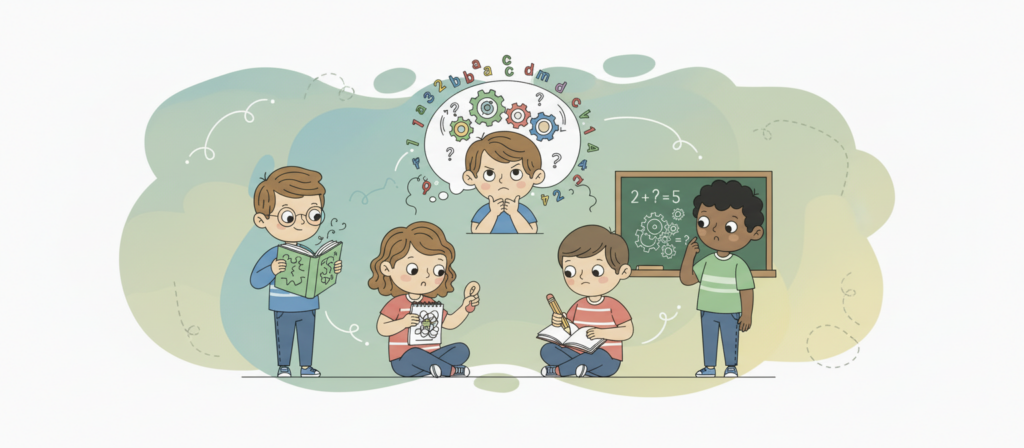
What is Specific Learning Disability
Specific Learning Disability (SLD) means a heterogeneous group of conditions wherein there is a deficit in processing language, spoken or written, that may manifest itself as a difficulty to comprehend, speak, read, write, spell, or to do mathematical calculations and includes such conditions as perceptual disabilities, dyslexia, dysgraphia, dyscalculia, dyspraxia and developmental aphasia, as per the notification given by the DEPwD, GoI, 4th Jan, 2018.
Guidelines for the purpose of assessing the extent of specified disability in a person included under the rights of person with disabilities Act, 2016(49 of 2016) Government of India(GoI)
Key Details on SLD, Department of Empowerment Persons with Disablities (DEPwD: GoI)
The Department of Empowerment of Persons with Disabilities (DEPwD) in India recognizes Specific Learning Disability (SLD)—including dyslexia, dysgraphia, and dyscalculia—as a disability under the RPwD Act, 2016. Amended guidelines (Dec 2020) allow for specialized assessment by medical authorities using the NIMHANS battery to issue disability certificates for SLD, facilitating access to education and support.
- Recognition: SLD is included under the 21 types of disabilities defined by the RPwD Act, 2016.
- Assessment & Certification: Guidelines emphasize that a positive result on the NIMHANS battery, confirmed by a psychiatrist or authorized medical board, is required for certification.
- Support Services: The National Institute for Empowerment of Persons with Multiple Disabilities (NIEPMD) works on developing teaching methods for individuals with SLD.
- Educational Support: Under the Samagra Shiksha scheme, children with SLD can access special education, assistive devices, and inclusive education initiatives.
- Documentation: Candidates with dyslexia are recognized for PwD (Persons with Disabilities) category benefits (e.g., in exams) upon submitting a valid, signed certificate.
Key Aspects of SLD Recognized:
- Dyslexia: Difficulty in reading.
- Dysgraphia: Difficulty in writing/spelling.
- Dyscalculia: Difficulty in mathematical calculations.
Screening:-
(i) The teachers of the public and private school shall carry out the screening in Class III or at eight years of age, whichever is earlier. The screening test is given in Figure 2. If in the screening shows test three or more answers are in “frequently” column, then the child should be referred for further assessment.
(ii) Every school (public and private) shall have a screening committee headed by the principal of the school. After applying the screening test, if an anomaly is detected then, the teacher should bring it to the notice of principal and screening committee of the school. The teachers shall interview the parents to assess their involvement and motivation regarding their child’s education. If the parents are motivated and screening questionnaire suggests SLD, then child should be referred for further assessment.
Diagnosis: The diagnosis will require a team approach involving a pediatrician and clinical or rehabilitation psychologist.
This would involve three steps:
(i) Step 1- Assessment of paediatrician: The paediatrician will do the initial assessment. This will involve a detailed neurological examination including vision and hearing assessment. It has to be ensured that the child has normal visual acuity and hearing before proceeding to next step.
(ii) Step 2: IQ Assessment: Child/ clinical psychologist will do the IQ assessment using MISIC or WISCIII. If the IQ is determined to be >85, then step 3 will be applied.
(iii)Step 3- SLD Assessment: This would involve application of specific psychometric tests for diagnosing SLD and giving it a severity scale.
Diagnostic Tool – National Institute for Mental Health and Neurosciences (NIMHANS) battery shall be applied for diagnostic test for SLD.
Medical Authority: The Medical Superintendent or Chief Medical Officer or Civil Surgeon or any other equivalent authority as notified by the State Government shall be head the certification authority. The medical authority will comprise of:
(a) The Medical Superintendent or Chief Medical Officer or Civil Surgeon or any other equivalent authority as notified by the State Government
(b) Pediatrician or Pediatric Neurologist (where available)
(c) Clinical or Rehabilitation Psychologist
(d) Occupational therapist or Special Educator or Teacher trained for assessment of SLD.
Validity of Certificate: The certification will be done for children aged eight years and above only. The child will have to undergo repeat certification at the age of 14 years and at the age of 18 years. The certificate issued at 18 years will be valid life-long.

Figure 1. The suggested flow for identification and certification of Children with suspected Intellectual Disability

Figure 2. The suggested flow for identification and certification of Children with suspected Specific Learning Disability (Doc. Reference No: 16-09/2014-DD-III)